Views
Cricket in 1900 - M.C.C. becomes tangled in the net - Part Two
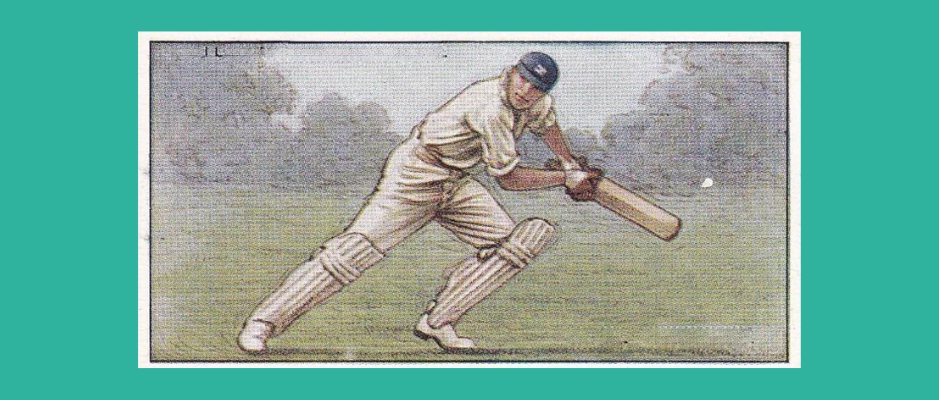
In Peter Bloor’s latest series timed as the Cricket Twenty Over World Cup takes place in India and Sri Lanka, he looks back to 1899 when the M.C.C tried to resolve the problem of high-scoring games which were proving to be far from entertaining to those that were watching.
‘The M.C.C. must take the matter into serious consideration’
Alarmed by the number of huge team and individual scores made on easy pitches in 1899, and by the number of one-sided matches or tedious draws that resulted, the M.C.C. took drastic action at its annual meeting in May 1900.
Rejecting such radical proposals as widening the wickets and narrowing the bat the M.C.C. decided that a trial should be conducted at Lord’s, where a net some 2 feet 6 high would be erected around the boundary and a new scoring system implemented. Shots that cleared or bounced over the net would score 3, and for those that hit or lodged in it 2 runs would be added to those the batsmen ran. The flaw was immediately clear – there was no reward for the better shots that flew over the net because they scored just 3, or for those that flew to it because they gave the batsman little time to run and add to his score of 2. However, an edge or a mistimed shot might well be rewarded because it travelled to the net more slowly, giving the batsmen that time to run, as did deliberately placed – and paced – shots hit just hard enough to reach the boundary.
‘When tried it was an absolute failure’
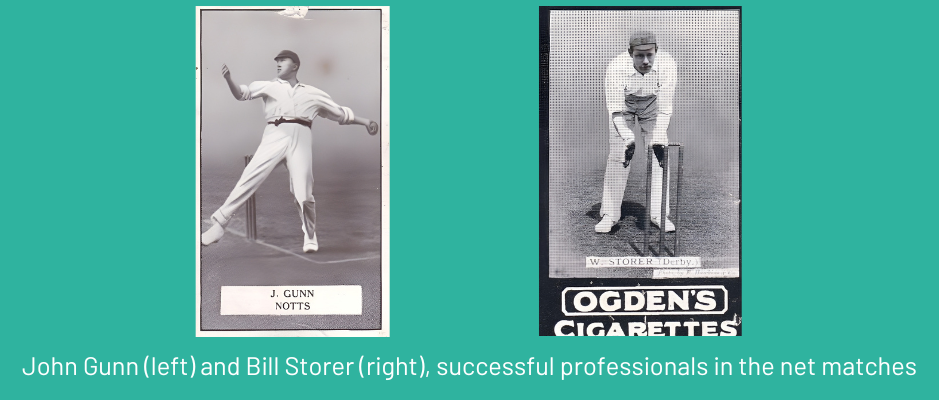
In May M.C.C. played five first-class matches “under the experimental rules.” In the first they lost by 8 wickets to Nottinghamshire, for whom John Gunn scored 53 not out and took 11 for 134, and then beat Leicestershire by 9 wickets. The rules were changed for the third match against Sussex – shots out of the ground would now score 6, those over the net 5 and those through, under or bouncing over it 4 – but this made little difference to M.C.C. who played very poorly and lost by 7 wickets, Cyril Bland taking 10 for 103 and George Cox 9 for 137. In their next match M.C.C. beat Yorkshire by 182 runs, Pelham Warner scoring 83 and 69 but then, in the last of the “net matches”, lost to Derbyshire by 107 runs.
The weather was not conducive to the success of the experiment, at various times being windy and showery, wet and during the Yorkshire match so cold that the fielding side found it difficult to feel and hold the ball. Crowds were pitifully small as, deterred by the weather and uninterested after the novelty of the first day against Nottinghamshire, spectators stayed away, as did the gentlemen amateurs – M.C.C. played just three against Sussex, and they were very obscure, and three against Yorkshire, whose side was entirely professional.
‘It is highly probable that the M.C.C. will revert to the old system’
Pelham Warner was one of the three against Yorkshire and wrote of the experience, confirming the flaws in the scoring system and adding another – how tired both batsmen and fielders became. The ball not going dead when it reached the boundary fielders were now obliged to retrieve and return every boundary shot while the batsmen now had to run for those they previously stood and watched get there. He was damning, writing that ‘the rules were so childish as to make one wonder how any cricketer could have suggested them’ and predicted that they would soon be abandoned.
‘Storer had reason to be entirely satisfied with his three days’ cricket’
He was quite correct. M.C.C. played just one more match under them, against Derbyshire, whose wicket-keeper Bill Storer took three catches, made a stumping, took 3 for 49 in M.C.C.’s second innings and scored 55 and 175 not out. He had evidently studied how to take advantage of the net - his 175 included two 7’s, five 6’s, and five 5’s - and his bold, vigorous hitting all around the wicket confirmed how punishing a set batsman who knew what he was doing could be, just as Alfred Lucas with 95 and Kingsmill Key with 101 had done in partnership for M.C.C. against Leicestershire - and they were far from being the youngest, fastest or lightest of men.

“That experiment failed…”
The net scheme had failed and, keen as he was for it or any other remedy to succeed, “An Old Blue” admitted it. Pondering the alternatives in his review of the season he returned to the idea, rejected by M.C.C. in May, of narrowing the bat, saying that if it were adopted “we should see much less of the system which devolves upon professionals the duty of bowling and leaves to amateurs the making of averages of huge size.”
In the five “net matches” Alfred Lucas, Kingsmill Key and Pelham Warner - all amateurs - had scored heavily for M.C.C., while George Cox, Cyril Bland and John Gunn - all professionals - had taken 9, 10 and 11 wickets respectively against them. There were exceptions of course - Bill Storer was a professional who had scored 175 for example - but for all its apparent radicalism the net scheme had changed little.
References
Credits: The quotes and other information in this article are taken from Cricket A Weekly Record, The Times and other newspapers 1899 and 1900. The idea for the piece came from an article about Bill Storer on the official Derbyshire CCC site
Images: Bill Storer Ogdens 1901, John Gunn and Pelham Warner both Gallaher 1926. Banner image Wills 1929
Comments: 0 (Add)
 RSS
RSSIn this section
Volunteers
We’re always on the lookout for volunteers to help run our clubs all across England, Scotland and Wales – find out more here.
Find a club
Want to know where your nearest Sporting Memories club is? View our Club Finder page here.