Views
Sportsmen of the Somme - The Fighting Fusilier

In the latest of our series reflecting on some of the sporting stars that ended up fighting for King and Country during the First World War, Peter Bloor looks upon on boxer Jerry Delaney and his quest to fight for titles before losing his life on the Somme.
Jerry Delaney, “the boxer who loves fighting and the fighter who loves boxing”
By the time the boxer Jerry (short for Jeremiah) Delaney enlisted with the 23rd Royal Fusiliers (1st Sportsman’s Battalion) in January 1915 he was unbeaten since the start of his career in 1911 and had been fighting since March 1914 for the right to a title bout with the World lightweight champion Fred Welsh in which a Lonsdale Belt would also be at stake.
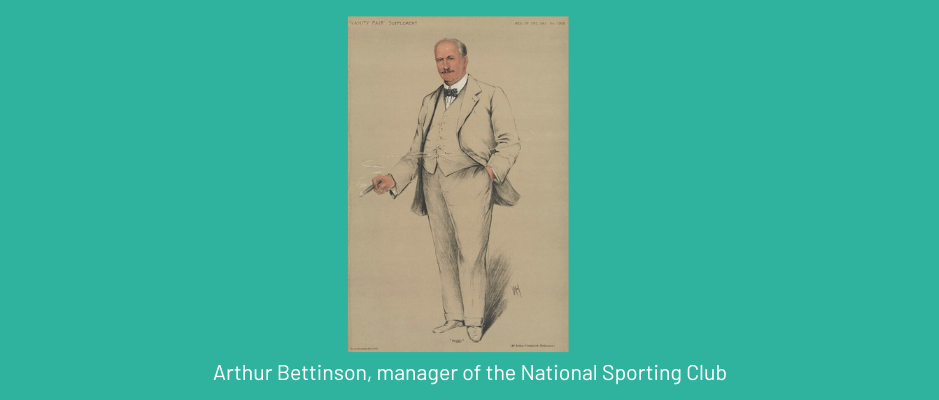
‘Mr. Bettinson knows a likely-looking boxer when he sets eyes on one’
In that March he had fought for the second time at the headquarters of British boxing the N.S.C., the National Sporting Club, where he outclassed Danny Hughes, flooring him repeatedly in the third and fourth rounds until the referee stopped the fight just as Hughes’ corner threw in the towel. Fifteen rounds had been scheduled but Jerry’s performance had been so impressive that Arthur Bettinson, the manager of the N.S.C., promised him a fight against Matt Wells with the winner to fight Welsh.
However, with Willie Farrell just one of the other recognised contenders the answer to the complicated question of who would finally fight the champion was not that easy to find and Jerry would contest six fights, not one, in his attempt to get to him.
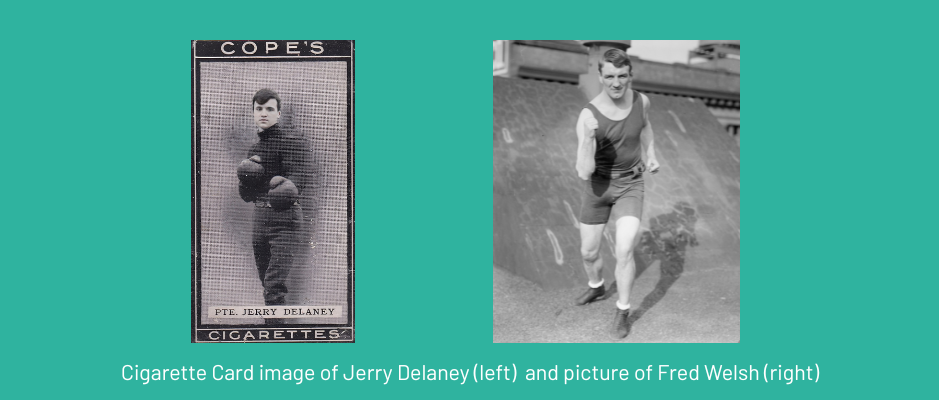
1914: ‘Delaney has improved wonderfully during the last few months’
Jerry won all six, the first at the end of March against Eugene Volair of France, who was disqualified in the seventh round for holding, the only counter he had to the pounding Jerry was giving him after being floored in the fifth. In April he met an unfit and overweight Willie Farrell who, unsurprisingly, didn’t last two rounds, and in May another Frenchman, Fernand Quendreux, who retired - although his corner may have made the decision, reports differ - at the end of the fifth round after Jerry had forced him all around the ring with left and right jabs that left him bleeding from his nose and mouth.
After four fights in three months Jerry still did not stop and in June he fought an American, Harry Stone, whose odd and unfamiliar methods included smoking long black cigars when in training and while weighing-in, moments of needlessly flashy footwork, annoying his opponents in clinches by not shaving and ending rounds with thirty seconds of whirlwind effort. He did though also combine wiliness with a fine defence but he was nonetheless unable to prevent Jerry’s cleaner, harder punching giving him such a margin of victory on points that while he was still waiting for Mr. Bettinson to announce “Delaney the winner!” Stone acknowledged his defeat by three times patting Jerry on the head.
“Private Jerry Delaney - Our Jerry - easily defeats Jack Denny”
Jerry did now pause his pursuit of Welsh, until February 1915 when he fought Jack Denny at the N.S.C. By this time he was in Hornchurch with the Sportsman’s Battalion, many of whose members took advantage of the half-price tickets that Jerry had arranged with Mr. Bettinson to watch him outclass Denny from the start and batter him all around the ring in the thirteenth and fourteenth rounds, after which his corner retired their man.
Jerry returned smiling to camp where Cyril Freer, the editor of the Battalion newspaper “The Sportsman’s Gazette”, asked him to write his impressions of the fight, to which Jerry replied that he would rather box a round than write a single line: taking the hint that the round would be boxed with him Freer then excused himself with an invented editorial matter and left - smartly.
“Delaney repeats over Farrell”
When Willie Farrell had fought Jerry in 1914 his training had been interrupted by illness and an injured ankle, and he had come in overweight with the ankle strapped. With Jerry at 10lb. disadvantage it was agreed that the outcome should have no bearing on either fighter’s right to challenge Welsh, which was just as well for Farrell who took such a pummelling in the second round that the referee stopped the fight.
The return at the N.S.C. in April 1915 was not billed as an eliminator but was generally regarded as such. On this occasion the fight went the full twenty rounds with Jerry winning on points and never looking like losing against a man who was fast, busy and who boxed cleverly, doing himself great credit and earning generous applause from the Sportsman’s Battalion contingent in the audience.
“Delaney selected to meet Welsh”
Jerry had now won six contests against five fighters in just over twelve months and, with its “soldiers first” policy also a consideration, in May 1915 the Committee of the N.S.C. nominated him as Fred Welsh’s challenger. However, a fortnight later he gave a performance far below the standard that would be required to beat Welsh when he beat Jack “Kid” Greenstock on a disqualification after seven rounds of too little boxing and too much holding, the referee losing patience with Greenstock first having already warned both men.
“Jerry Delaney killed in action”
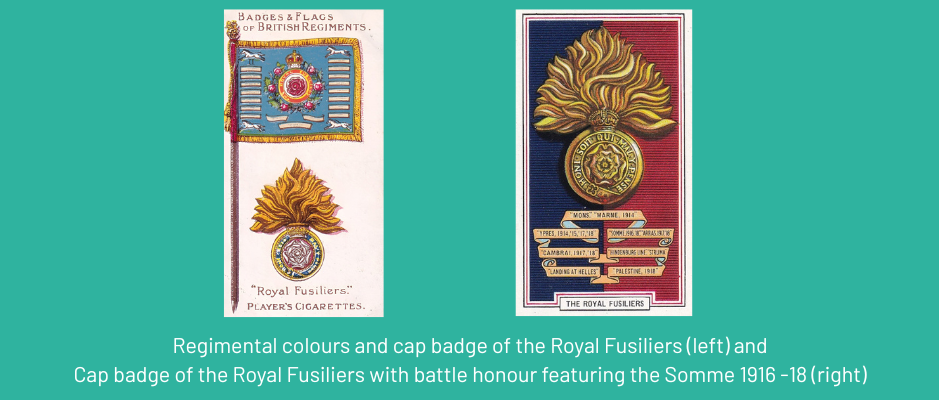
The N.S.C. closed its doors for the summer on May 31st and its Committee had only told Welsh that he would be obliged to defend his title after it had re-opened in October. However, Welsh had still not returned from the United States - where he lived - by November 1915 when the Sportsman’s Battalion was mobilised to France, where Jerry was killed in the attack on Delville Wood on July 27th 1916.
He died not knowing whether he was good enough to have beaten Welsh or not, but he remained a fighter to the very end - shortly after his death a former comrade, Frank Harris, told the London Evening News that “Jerry was always on hand during night raids on enemy trenches. He loved fighting and was never so happy as when, festooned with bombs [grenades], he crept over into no-man’s land.” He was also a boxer to the end - Harry Hooper, a fellow boxer in the Sportsman’s Battalion, also wrote, to The Sporting Life, recalling fondly his time with Jerry during which ’We gave a show at all our concerts and boxed an exhibition the night before going into action to keep the lads in good spirits. That was poor Jerry’s last show and he was boxing splendidly. The game has lost one of its best.’
References
The information and quotes in this article are taken from Boxing World and Mirror of Life, the Sporting Life, local Birmingham and Bradford newspapers, “The Sportsman’s Gazette” of 26th February 1915 and Jerry Delaney’s page on BoxRec (login may be needed)
Images: Banner image Boguslavsky 1925, Jerry Delaney Copes 1915, Royal Fusiliers colours and badge Players 1903, Royal Fusiliers cap badge Gallaher 1939.
Fred Welsh: Bain News Service, publisher Public domain, via Wikimedia Commons
Arthur Bettinson: Arthur Frederick Bettinson (‘Men of the Day. No. 1306. “Peggy.”’), by (Richard) Wallace Hester (‘W. Hester’, ‘Hester’, ‘WH’ and ‘WH-’) chromolithograph, published in Vanity Fair 22 November 1911 NPG reference D45637 © National Portrait Gallery, London
Comments: 0 (Add)
 RSS
RSSVolunteers
We’re always on the lookout for volunteers to help run our clubs all across England, Scotland and Wales – find out more here.
Find a club
Want to know where your nearest Sporting Memories club is? View our Club Finder page here.