Views
Developing our work through Occupational Therapy
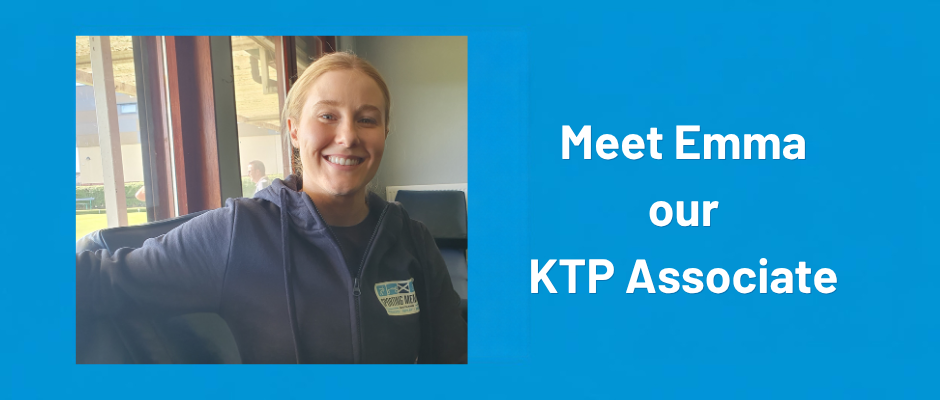
In the summer, Sporting Memories began a Knowledge Transfer Partnership (KTP) with Edinburgh Napier University that will aim to adapt our activities to specific needs of individual Club members and enhance their experience and deepen our impact.
For the KTP, we have welcomed Emma McBride, an Occupational Therapist (OT) with Napier University, as an Associate to help delve into our work and she has already visited quite a few of our Scottish clubs. Emma has already been making more than a few important observations as she details in our conversation below.
Emma, welcome and we wish you a great time with Sporting Memories. Can you first of all give us a little background about this relationship between Sporting Memories and OT?
The relationship between Sporting Memories and occupational therapy began to develop through Edinburgh Napier University, when students began to complete practice education placements, as part of their MSc (Pre Reg.) Occupational therapy programme, with Sporting Memories clubs in Fife. Students from Edinburgh Napier University worked alongside members and volunteers to explore how occupational therapy could contribute to the clubs, developing resources in response to what they observed and what members told them.
These placements were, and continue to be, successful and demonstrated the potential for a closer partnership. In 2026 Sporting Memories and Edinburgh Napier University began a KTP, supported by Innovate UK, to embed OT expertise within the organisation.
Thanks for that insight into the background of the project, but could you tell us a bit more about your background?
I joined the partnership as the KTP Associate in August 2026. I am an occupational therapist and have spent most of my clinical career working with older adults in Scotland and New Zealand, including people living with dementia, frailty and complex social circumstances. A large part of my work as an occupational therapist has involved finding ways for older people to keep doing the activities (occupations) that matter to them despite changes in their health, abilities or circumstances. Alongside clinical practice, I have developed a strong interest in research, and in bringing the two together.
How have you found your visits to Clubs so far?
One of the biggest things that struck me when visiting clubs was how long people had been coming for. Most of the people I spoke to had been attending for years.
What also stood out to me was that, in this setting, older adults were not just passive recipients of a programme. They took active roles. I saw members lead activities and discussions, make cups of tea and coffee for each other and share incredible amounts of knowledge. This is in stark contrast to how we sometimes see older adults in society: spending large amounts of time alone, devoid of activity and social interaction.
The clubs also seemed to create the right environment for people’s existing knowledge, skills and abilities to come through.
Do you have any examples of this that you could share?
One man had dementia that was affecting his language, and I could see him struggling to follow verbal instructions. But when he was included in a game of darts, he beat every person in the room.
Another woman had given up her bowls group because of an injury. She told me she had almost decided not to come to Sporting Memories because she was quiet and did not know much sports trivia. But a few weeks in, it was clear that she had become a valued member of the group. People knew about her life, and she shared a powerful story about her fight to allow women to join her bowling club.
Those kinds of moments completely change the story about someone’s abilities.
So how will you support our work in your role as a KTP associate?
What Sporting Memories has already done is create a successful model to bring older people together. That is half the battle already won. Our goal is to combine this with OT expertise to use what happens within clubs to further target health and wellbeing. Over the course of the partnership, we will work to create an enhanced model for the clubs that draws on the current evidence about healthy ageing and give volunteers practical skills to recognise and remove barriers to participation, so that every member can get the full benefit of attending.
Away from work, what other interests do you have?
Sport has also played an important role in my own life.
I started Olympic weightlifting classes at a challenging time in my life. Initially, it gave me an exercise routine and something new to be passionate about, but it quickly became much more than exercise. I made friends, developed an interest in watching and supporting the sport and, when I moved to New Zealand, joining a barbell club gave me a way to find a new community there.
More recently, starting netball again after returning to Glasgow has done something similar. It has helped me meet people in my community while reconnecting me with an important part of my identity when I was younger.
So, both professionally and personally, I was interested in the idea of sport bringing people together and being a medium for holistic health and wellbeing.
Thank you Emma for taking time to speak with us and we do look forward to following closely this project. Exciting times!
Comments: 0 (Add)
 RSS
Volunteers
We’re always on the lookout for volunteers to help run our clubs all across England, Scotland and Wales – find out more here.
Find a club
Want to know where your nearest Sporting Memories club is? View our Club Finder page here.
