Views
Sportsmen of the Somme - Leading From The Front
In the latest of our series reflecting on some of the sporting stars that ended up fighting for King and Country during the First World War, Peter Bloor explores the England rugby international Alf Maynard, who also played cricket for his county Durham before joining the war efforts.
The 18-year-old playing for Cambridge
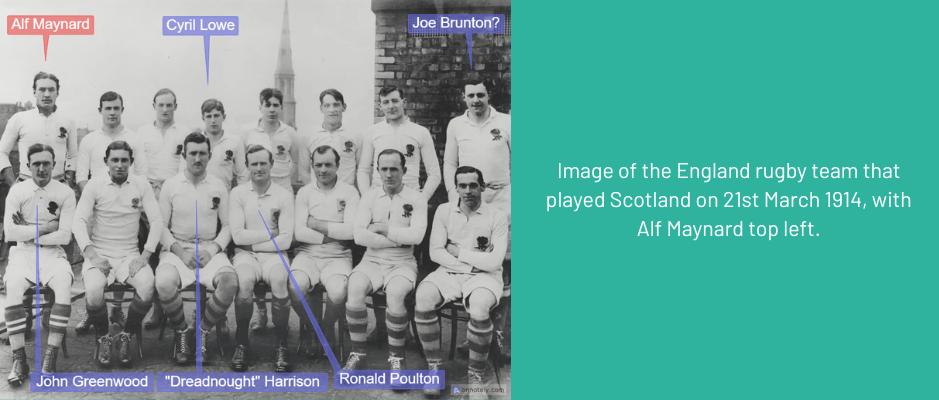
When Alf Maynard made his debut for England against Wales in January 1914, he was playing his rugby for Cambridge University with two other members of the England side, Cyril Lowe and John Greenwood. All three had played in the victories over Oxford in the Varsity matches of December 1912 and 1913, in the second of which Alf had scored an unlikely try after either intercepting a pass from Freddie Knott or taking the ball from him after he had fumbled it, reports differ, and setting off for the try-line.
Running at no great speed straight along the touchline and seemingly hoping that a faster, better-positioned team-mate would make himself available for a pass he continued on, barely hindered by the attempted tackles of the Oxford players who, some suggested, had decided that such a big, powerful forward would not be able to run three-quarters the length of the pitch. They were wrong, and having made sufficient progress up the field Alf, with no team-mate having appeared, decided that he might as well finish the job himself, which he did by touching down in the corner.
The 1913-14 Trial matches - ‘None were better than A.F. Maynard and J. Brunton’
Eleven days later Alf played for The North in a trial match at Gosforth against England - he did have connections to the region having attended Durham School, a public school of course - and was one of the three best forwards on the pitch, not just for The North. Having impressed he then appeared for England versus The Rest in a puzzling final trial before the first match of the international championship against Wales. Alf impressed again, so much so that the correspondent of the Morning Post suggested that the selectors could resolve one of the questions the match left unanswered by first picking him, John Greenwood and Charles “Cherry” Pillman and then the other five forwards by drawing lots.
“The 19-year-old playing for England”
The selectors did pick Alf for his first international, one in which the England forwards were dominated in the scrum by their Welsh opponents, not always using methods that were within the rules, Alf being one victim of their excesses when he was punched squarely on the jaw. Undeterred he shone in the loose and, always prominent in the forward rushes, he was one of the few forwards to emerge with credit from a match England only won 10-9 thanks to the brilliance of their captain Ronald Poulton.
Having demonstrated that he could not be intimidated Alf kept his place for the next match against Ireland, whose forwards were fully expected to adopt their famous “wild and whirling methods.” This they duly did, disrupting the English forwards until, with Alf prominent, they gathered themselves, ceased scrambling and became an eight that played as the Irish did, as one, Alf and Joe Brunton also finding the time and space for a short passing move that made the opening for a try by Alf’s Cambridge team-mate Cyril Lowe.
England beat Ireland 17-12, and won for the third time in Alf’s three international appearances, against Scotland at Inverleith, a match in which all of the England forwards looked flat and stale but were kept going by H.C. “Dreadnought” Harrison as England held onto their 16-15 lead despite the Scots’ late efforts to overturn that one-point deficit.
‘…and it will be understood how we in the north country regarded his prospects’
Alf missed the final match of the international championship against France, as he did Durham’s County Championship final against Midland Counties for which he was injured. Alf had barely featured in Durham’s run to the final anyway but he had played in their 23-0 victory over Cumberland on a heavy, rain-soaked pitch that did not disguise Durham’s forward superiority in both the scrum and the open, nor Alf’s pace and skill, such as that he displayed when he dribbled through and touched down for a solo try.
‘In 1913 and 1914 he made useful scores for the Durham County cricket eleven’
That was the last occasion on which Alf represented Durham in rugby, but not in all sport, for in 1914 he again represented the county in cricket, playing in the Minor Counties Championship as he had in 1913.
On August 4th 1914 he made a powerful and resourceful 54 in Durham’s second innings against Northumberland: at 11 o’clock that night war was declared. On the 5th and 6th Cumberland were Alf’s opponents in a friendly match, but now on a cricket rather than a rugby pitch he had less success against them, making 1 and 18 not out, before making 29 against Cheshire on the 10th in what proved to be his last innings for Durham before the war brought a premature end to their season.
“The death in the fighting of one of England’s most brilliant young forwards”
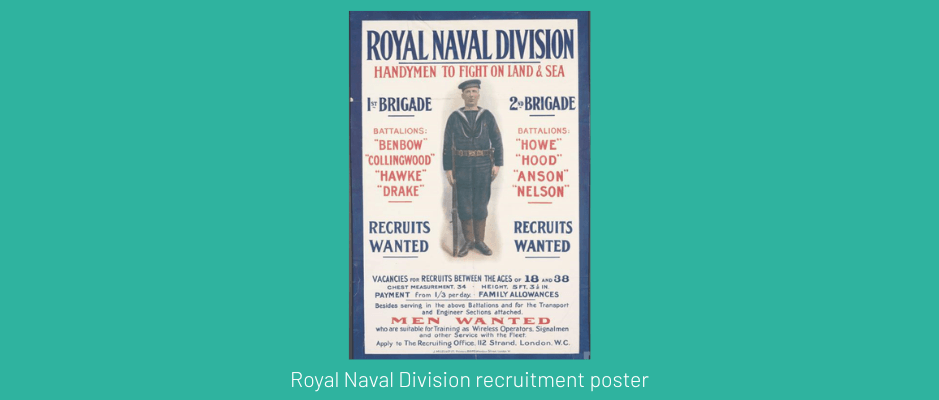
Alf was quick to volunteer with the Royal Naval Volunteer Reserve and was assigned to the Royal Naval Division, an infantry formation conceived by Churchill in 1914 and made up of naval reservists for whom there were no ships. He was serving with the RND on November 13th 1916, the first day of the Battle of the Ancre and one of the last of the Somme campaign, when the Howe Battalion attacked Beaucourt. On a day of confused fighting Alf was killed leading A Company forward through thick mist, behind an artillery barrage and into resolute German resistance.
His commanding officer, Colonel Ramsay-Fairfax, wrote to Alf’s parents expressing the heartfelt sympathy of all members of the Battalion on the death of their son, who ‘I knew to be not only a zealous officer but one in whom the greatest confidence might well be placed.’ When he was killed Alf Maynard, who had been so trusted by both the England selectors and his commanding officer, was just 22-years-old.
References
Credits: the information and quotes in this article are taken from The Times, the Athletic News, the Morning Post, the Daily Chronicle, the Newcastle Journal, the Durham County Advertiser and other local newspapers from north-east England 1912-1916.
Details of the RND attack on Beaucourt from the Howe Battalion War Diary, The National Archives reference WO-95-3111-2_01.
Images: England team photograph taken from the Commonwealth War Graves Commission site, copyright unknown. Royal Naval Division poster Imperial War Museum reference IWM (Art.IWM PST 0896). Banner image Boguslavsky (1925)
Comments: 0 (Add)
 RSS
Volunteers
We’re always on the lookout for volunteers to help run our clubs all across England, Scotland and Wales – find out more here.
Find a club
Want to know where your nearest Sporting Memories club is? View our Club Finder page here.
